Shopping Cart
There are no more items in your cart


How to measure surfboard volume: calculator guide


Learning how to measure surfboard volume accurately is not a minor detail. A difference of three litres determines whether a board catches a waist-high wave or stalls behind it. This guide explains how to calculate surfboard volume so you secure the correct buoyancy for your local lineup.
How to measure and calculate surfboard volume
Surfboard volume defines the physical space your equipment occupies in the water. That figure governs how high you sit above the surface and how cleanly you paddle into a wave. Underestimating your ideal volume by even a small margin will noticeably reduce your daily wave count.
Why surfboard volume matters for your performance
Foam distribution controls paddle momentum and wave entry speed. Knowing how to calculate surfboard volume in litres gives you a concrete benchmark to compare different shapes against one another. Length alone is deceptive: two boards of similar size can carry vastly different buoyancy profiles.
Riding a shape with insufficient displacement directly hinders progression. Too little foam makes paddling laborious and reduces stability at takeoff. To find your ideal volume, you must match your physical weight to your actual skill level, not the level you aspire to.
- Buoyancy and stability: Higher volume keeps the deck above the surface, reducing the effort required during your pop-up.
- Paddling efficiency: Additional foam increases surface contact and maintains forward momentum through weaker sections.
- Turning responsiveness: Lower volume sinks the rail deeper, producing tighter arcs on steep, powerful faces.
- Progression over time: A beginner requiring 70 litres today will move toward a smaller capacity as technique develops.
Our surfboard volume calculator at Mundo-Surf.com matches your body weight directly to the correct shape. Using this volume calculator removes the guesswork from your next equipment decision.
How to calculate surfboard volume in litres manually
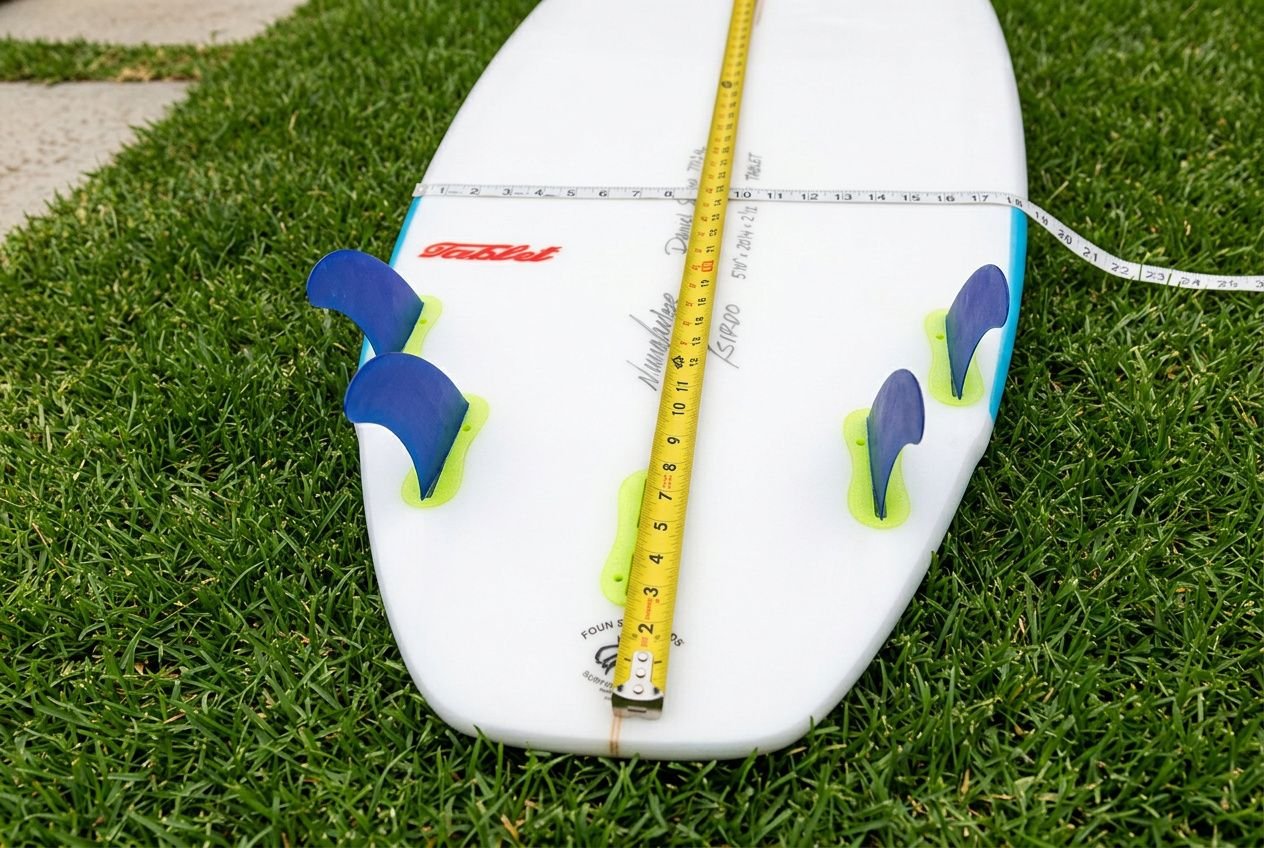
The basic formula requires three precise measurements: length, width, and surfboard thickness. How to check surfboard volume manually takes two minutes with a standard tape measure. You multiply these dimensions by a shape-specific factor to arrive at the displacement figure.
Calculating surfboard volume also requires adjusting for rocker and rail taper. A high-performance shortboard uses a factor of 0.54; thicker shapes sit closer to 0.60. In practice, the volume written on a surfboard stringer is often the quickest way to confirm the board volume without recalculating surfboard geometry from scratch.
How to check surfboard volume by weight and skill level
The Guild Factor ratio pairs your physical mass with water displacement. A dedicated surfboard volume calculator app handles this instantly, though the calculation itself is straightforward. Determine the ratio by dividing the board's capacity by your body weight in kilograms.
To calculate surfboard requirements, multiply your body mass by the appropriate proficiency factor. An intermediate 70 kg surfer targets approximately 60 litres. Cold water and winter neoprene always call for a modest increase in foam volume.
| Skill level | GF ratio range | Recommended volume (70 kg surfer) | Notes |
| Beginner | 0.40–0.50 | 65–75 L | Prioritise stability and paddle ease |
| Intermediate | 0.38–0.42 | 55–65 L | Balance between flotation and responsiveness |
| Advanced | 0.36–0.38 | 35–45 L | Performance over stability |
| Expert / fit | 0.34–0.36 | 25–30 L | Maximum manoeuvrability, minimal flotation margin |
How to estimate surfboard volume for your board type
Your preferred board type sets the baseline capacity before any formula is applied. Shortboards sit between 25 and 35 litres; longboards exceed 60. Knowing how to estimate surfboard volume by category ensures you select the correct equipment for your local conditions, not just your preferred aesthetic.
- Shortboard volume: These performance shapes run from 22 to 35 litres, offering minimal drag for advanced riders on steep, hollow waves.
- Mid-length volume: Foam concentrated through the chest area supports paddle power without sacrificing manoeuvrability. I would point any surfer in inconsistent summer conditions toward a mid-length surfboard volume as the most practical middle ground.
- Longboard and funboard volume: The surfboard volume guide for the Super Magnum confirms that each additional foot of length contributes meaningfully to the beginner-friendly stability the format is built around.
Concretely, calculating surfboard dimensions by hand serves mainly to verify manufacturer specifications. What actually changes your decision is combining those factory figures with your personal Guild Factor ratio. The position we hold at Mundo-Surf.com, across a catalogue of 6,000 products, is that measured data always outperforms guesswork when building a considered quiver.
Frequently asked questions
How many litres of surfboard do I need for 90 kg?
At 90 kg, a beginner surfer needs between 80 and 95 litres to maintain stability and effective paddling. An intermediate surfer at the same weight should aim for 60 to 75 litres, and an advanced rider can reasonably come down to 35 to 45 litres. In practice, poor surf conditions and the added weight of a thick winter wetsuit push the right choice toward the upper end of each range.
What is a good volume for a surfboard at intermediate level?
An intermediate surfer should work with a volume ratio of 0.38 to 0.42, roughly 50 to 65 litres for a 70 kg rider. That range preserves paddle power in weak surf while allowing clean rail-to-rail transitions. I would choose the higher end for forgiving beach breaks, and drop toward the lower limit only when the conditions are steep and well-defined, such as a reef setup.
Can a surfboard have too much volume for a competent surfer?
Excess volume stops the rail from engaging properly: the board floats above the water rather than driving through it. Beyond the intermediate stage, too much foam reduces rotation speed and removes control on steeper faces. Concretely, an advanced surfer on a 70-litre board will find bottom turns imprecise and the pivot point undefined.
Share this article: