Shopping Cart
There are no more items in your cart


Surfboard volume calculator for weight and skill level


Finding the ideal surfboard volume for your weight and skill level can dramatically improve your overall surfing experience. This guide explains how a surfboard volume calculator works and why understanding board volume is so important. Whether you’re a beginner seeking extra buoyancy or an advanced surfer prioritizing maneuverability, knowing how to find your ideal volume will help you catch more waves.
Surfboard volume calculator by weight and skill level
A surfboard volume calculator connects your body weight—in either kilograms or pounds—with your experience level. Using these inputs, it recommends an ideal volume tailored to factors like your fitness and local wave conditions. This tool takes the guesswork out of choosing a board and provides a truly personalized recommended volume.

How to use a surfboard volume calculator
Using a volume calculator is straightforward: simply enter your weight and select your skill level. The tool applies a mathematical formula, multiplying your weight in kilograms (or pounds) by a factor based on your experience. In just seconds, you’ll get an accurate recommendation for your volume in liters.
- Enter your weight: Input how much you weigh, using either kilograms or pounds. The calculator automatically converts between units.
- Select your skill level: Choose from categories like beginner to advanced so the tool reflects your true experience level.
- Adjust for conditions: Consider the type of waves you usually surf—this fine-tunes the recommended volume range.
Once you’ve entered your details, the calculator shows a recommended volume range, balancing flotation with performance. Many calculators also suggest alternative volumes for different surfboard shapes and materials. This makes it easy to compare, say, a shortboard with a funboard—helping you find your ideal volume.
How to calculate surfboard volume from dimensions
You can also calculate volume manually from your surfboard’s dimensions using a simple formula. Measure the board's length, width, and thickness in centimeters. Then, apply the formula along with a shape factor that adjusts for the board’s contours—this is often how a surfboard volume chart is built.
The basic formula is: Volume (L) = (Length × Width × Thickness × Shape Factor) ÷ 1000. The shape factor typically ranges from 0.54 to 0.60, depending on the board's design. For example, a 180 cm board with a factor of 0.58 gives roughly 36.6 liters, confirming the manufacturer's board volume specs.
Surfboard volume chart by weight and skill level
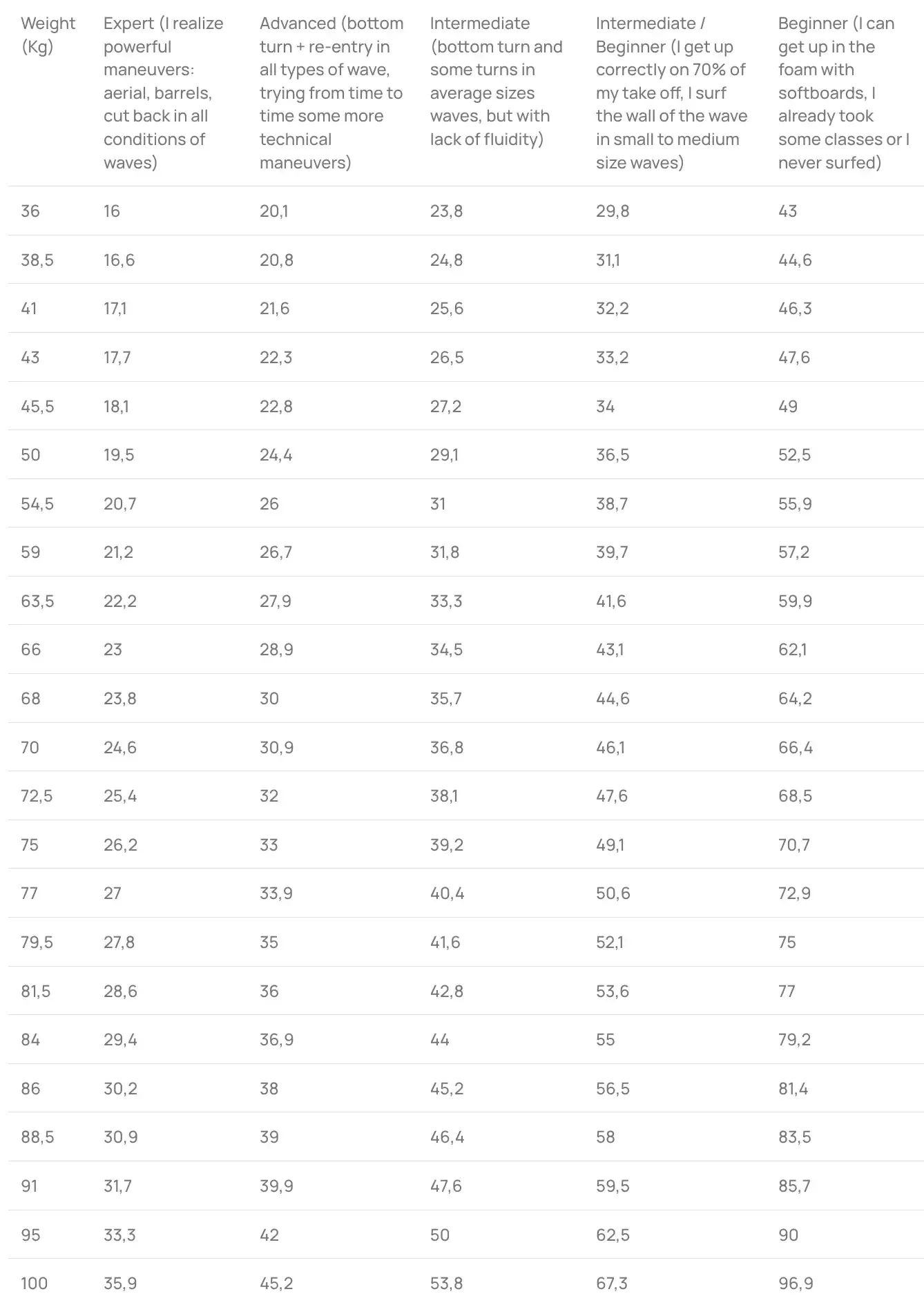
A detailed surfboard volume chart provides recommendations for a wide range of surfers, showing how weight and skill level affect ideal volume. This chart makes it easy to quickly find your ideal range, ensuring that the answer to what is a good volume for a surfboard directly reflects your body weight and progression.
The volume chart offers suggestions for every skill category, illustrating how your needs change as you improve. For instance, a beginner might need 70 liters, but what volume surfboard for 70 kg works for an advanced surfer? That number drops to just 28–35 liters, showing how improved balance and technique reduce the need for flotation.
Recommended products
Frequently Asked Questions
To find your ideal board volume, simply enter your weight in kilograms (or pounds) and then select your skill level, such as beginner or advanced. The surfboard volume calculator will then use a specific formula to provide your recommended volume. This formula multiplies your weight by a factor based on your experience level to determine the precise number of liters you need.
For a 70 kg beginner, we recommend a board with a recommended volume of 65 to 75 liters for excellent stability and flotation. For an advanced surfer of the same weight, the ideal volume drops significantly to 25 to 30 liters. This clear difference highlights just how crucial your weight and skill level are when using a volume calculator—your proficiency directly influences the ratio used in the calculation.
Your base recommended volume provides a great starting point, but the type of waves you plan to surf will influence your final choice. Generally, small, softer waves favor a board with a bit more volume for extra flotation, while powerful, hollow waves (like reef breaks) often perform better with a slightly lower volume. Your personal fitness and the board's design can also fine-tune these baseline preferences.
Share this article: